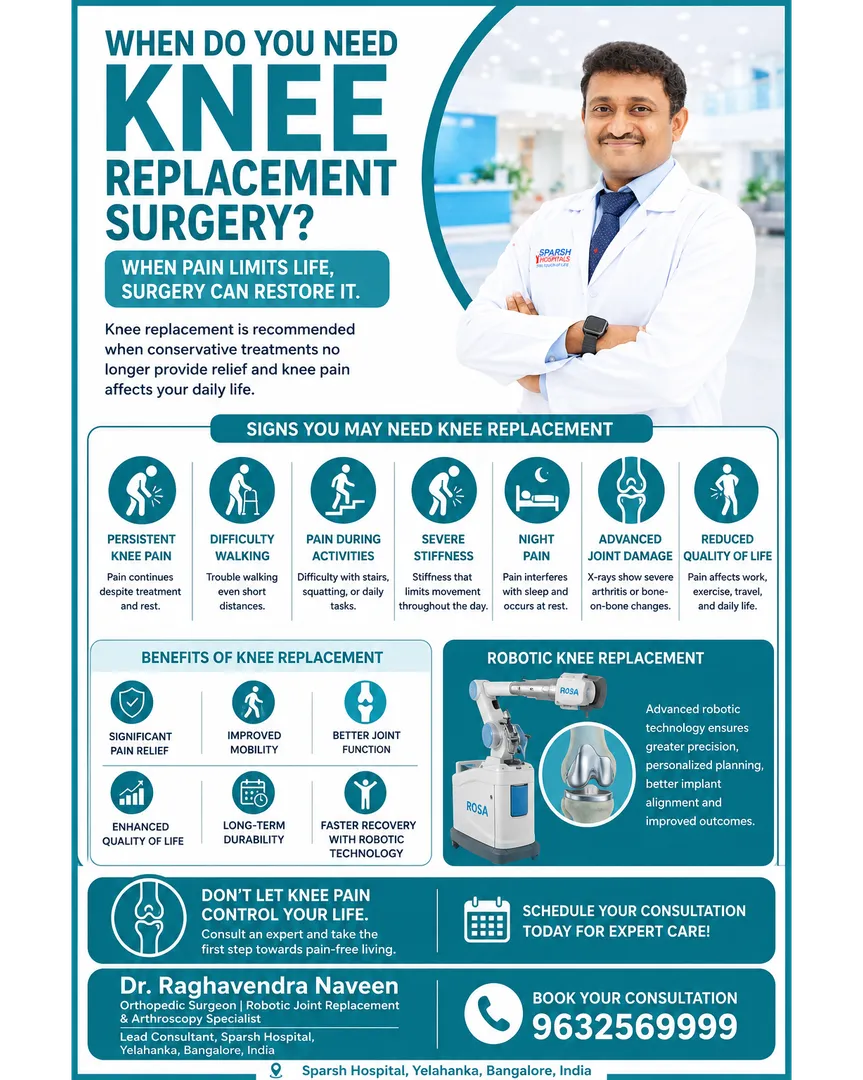
# When Do You Need Knee Replacement Surgery?
**Dr. Raghavendra Naveen**
**Orthopedic Surgeon | Robotic Joint Replacement & Arthroscopy Specialist**
**Lead Consultant, Sparsh Hospital, Yelahanka, Bangalore**
📞 **9632569999**
Knee replacement surgery is one of the most successful treatments for advanced knee osteoarthritis. While many patients benefit from medications, physiotherapy, PRP, and injections, surgery may become necessary when knee pain significantly affects daily life and conservative treatments no longer provide relief.
## Signs You May Need Knee Replacement Surgery
### Persistent Knee Pain
Pain continues despite medications, physiotherapy, injections, and lifestyle modifications.
### Difficulty Walking
Walking short distances becomes painful or requires support.
### Pain During Daily Activities
Difficulty climbing stairs, getting up from a chair, squatting, or performing routine tasks.
### Severe Morning Stiffness
Knee stiffness persists and limits movement throughout the day.
### Night Pain
Pain interferes with sleep and occurs even during rest.
### Significant Joint Damage
X-rays show severe cartilage loss, joint space narrowing, deformity, or bone-on-bone arthritis.
### Reduced Quality of Life
Knee pain prevents participation in work, exercise, travel, or social activities.
## Who Is a Candidate for Knee Replacement?
You may be a suitable candidate if:
* You have advanced knee osteoarthritis
* Conservative treatments have failed
* Knee pain is severe and persistent
* Daily activities are significantly restricted
* Imaging confirms advanced joint damage
## Benefits of Modern Knee Replacement
✔ Significant pain relief
✔ Improved mobility
✔ Better joint function
✔ Enhanced quality of life
✔ Long-term durability
✔ Faster recovery with robotic-assisted technology
## Robotic Knee Replacement
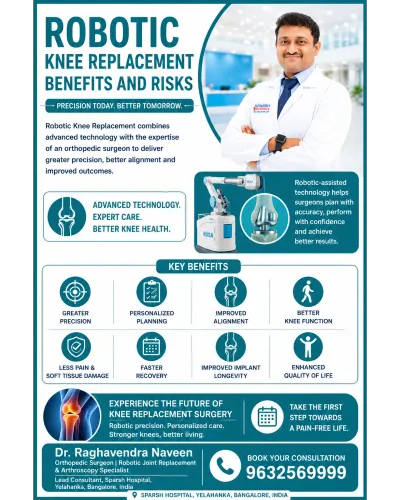
Robotic-assisted knee replacement allows greater surgical precision, improved implant positioning, personalized planning, and potentially faster rehabilitation compared to conventional techniques.
## Do's
✔ Maintain a healthy body weight
✔ Continue strengthening exercises before surgery
✔ Follow physiotherapy recommendations
✔ Control diabetes and other medical conditions
✔ Discuss all treatment options with your surgeon
✔ Attend regular orthopedic follow-ups
## Don'ts
❌ Delay treatment despite severe symptoms
❌ Ignore progressive deformity or mobility loss
❌ Depend solely on painkillers for long periods
❌ Avoid physical activity completely
❌ Skip rehabilitation after surgery
❌ Postpone consultation when quality of life is affected
## Frequently Asked Questions
**What is the right age for knee replacement?**
There is no fixed age. The decision depends on pain severity, joint damage, activity level, and overall health.
**How do I know if my arthritis is severe enough for surgery?**
Persistent pain, reduced mobility, failure of conservative treatment, and advanced X-ray changes are common indicators.
**How long does a knee replacement last?**
Modern knee implants often last 15–20 years or longer depending on activity level and overall health.
**Is robotic knee replacement better?**
Robotic technology can improve implant accuracy and alignment, which may contribute to better outcomes.
**How soon can I walk after surgery?**
Most patients begin walking with assistance within a day after surgery and continue rehabilitation thereafter.
## Book Your Consultation
**Dr. Raghavendra Naveen**
Orthopedic Surgeon | Robotic Joint Replacement & Arthroscopy Specialist
Lead Consultant, Sparsh Hospital, Yelahanka, Bangalore
📞 **9632569999**
**Dr. Raghavendra Naveen**
**Orthopedic Surgeon | Robotic Joint Replacement & Arthroscopy Specialist**
**Lead Consultant, Sparsh Hospital, Yelahanka, Bangalore**
📞 **9632569999**
Knee replacement surgery is one of the most successful treatments for advanced knee osteoarthritis. While many patients benefit from medications, physiotherapy, PRP, and injections, surgery may become necessary when knee pain significantly affects daily life and conservative treatments no longer provide relief.
## Signs You May Need Knee Replacement Surgery
### Persistent Knee Pain
Pain continues despite medications, physiotherapy, injections, and lifestyle modifications.
### Difficulty Walking
Walking short distances becomes painful or requires support.
### Pain During Daily Activities
Difficulty climbing stairs, getting up from a chair, squatting, or performing routine tasks.
### Severe Morning Stiffness
Knee stiffness persists and limits movement throughout the day.
### Night Pain
Pain interferes with sleep and occurs even during rest.
### Significant Joint Damage
X-rays show severe cartilage loss, joint space narrowing, deformity, or bone-on-bone arthritis.
### Reduced Quality of Life
Knee pain prevents participation in work, exercise, travel, or social activities.
## Who Is a Candidate for Knee Replacement?
You may be a suitable candidate if:
* You have advanced knee osteoarthritis
* Conservative treatments have failed
* Knee pain is severe and persistent
* Daily activities are significantly restricted
* Imaging confirms advanced joint damage
## Benefits of Modern Knee Replacement
✔ Significant pain relief
✔ Improved mobility
✔ Better joint function
✔ Enhanced quality of life
✔ Long-term durability
✔ Faster recovery with robotic-assisted technology
## Robotic Knee Replacement
Robotic-assisted knee replacement allows greater surgical precision, improved implant positioning, personalized planning, and potentially faster rehabilitation compared to conventional techniques.
## Do's
✔ Maintain a healthy body weight
✔ Continue strengthening exercises before surgery
✔ Follow physiotherapy recommendations
✔ Control diabetes and other medical conditions
✔ Discuss all treatment options with your surgeon
✔ Attend regular orthopedic follow-ups
## Don'ts
❌ Delay treatment despite severe symptoms
❌ Ignore progressive deformity or mobility loss
❌ Depend solely on painkillers for long periods
❌ Avoid physical activity completely
❌ Skip rehabilitation after surgery
❌ Postpone consultation when quality of life is affected
## Frequently Asked Questions
**What is the right age for knee replacement?**
There is no fixed age. The decision depends on pain severity, joint damage, activity level, and overall health.
**How do I know if my arthritis is severe enough for surgery?**
Persistent pain, reduced mobility, failure of conservative treatment, and advanced X-ray changes are common indicators.
**How long does a knee replacement last?**
Modern knee implants often last 15–20 years or longer depending on activity level and overall health.
**Is robotic knee replacement better?**
Robotic technology can improve implant accuracy and alignment, which may contribute to better outcomes.
**How soon can I walk after surgery?**
Most patients begin walking with assistance within a day after surgery and continue rehabilitation thereafter.
## Book Your Consultation
**Dr. Raghavendra Naveen**
Orthopedic Surgeon | Robotic Joint Replacement & Arthroscopy Specialist
Lead Consultant, Sparsh Hospital, Yelahanka, Bangalore
📞 **9632569999**
Keywords