Robotic vs Traditional Knee Replacement – Which is Better?
Expert Knee Replacement Guide by Dr. Raghavendra Naveen | Bangalore
📞 Call Now: 9632569999
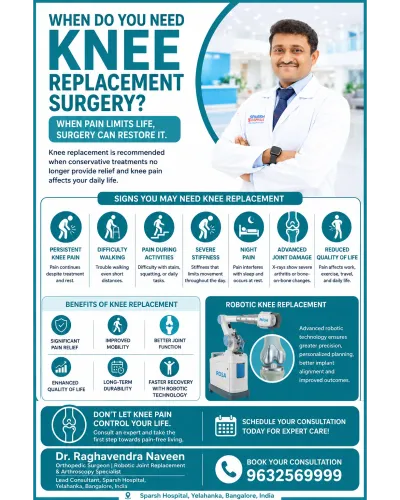
Knee arthritis is one of the most common causes of chronic pain and reduced mobility. When non-surgical treatments fail, knee replacement becomes the best solution. Today, patients often ask:
👉 “Should I choose robotic knee replacement or traditional knee replacement?”
At our centers in Yelahanka & Hebbal, Bangalore, Dr. Raghavendra Naveen offers both advanced options, helping patients choose the most suitable treatment for long-term success.
🔍 Understanding the Two Techniques
🔹 Traditional Knee Replacement
A conventional surgical method where the surgeon uses manual instruments to replace the damaged knee joint.
✔ Proven technique with long-term results
✔ Widely practiced worldwide
✔ Outcome depends on surgical precision
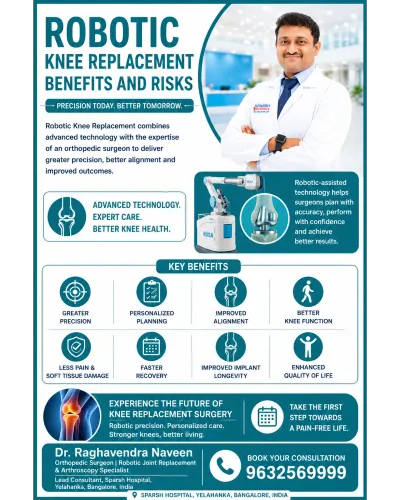
🤖 Robotic Knee Replacement
An advanced technique where robotic technology assists the surgeon with 3D planning and real-time accuracy.
✔ Computer-guided precision
✔ Better implant alignment
✔ Minimal soft tissue damage
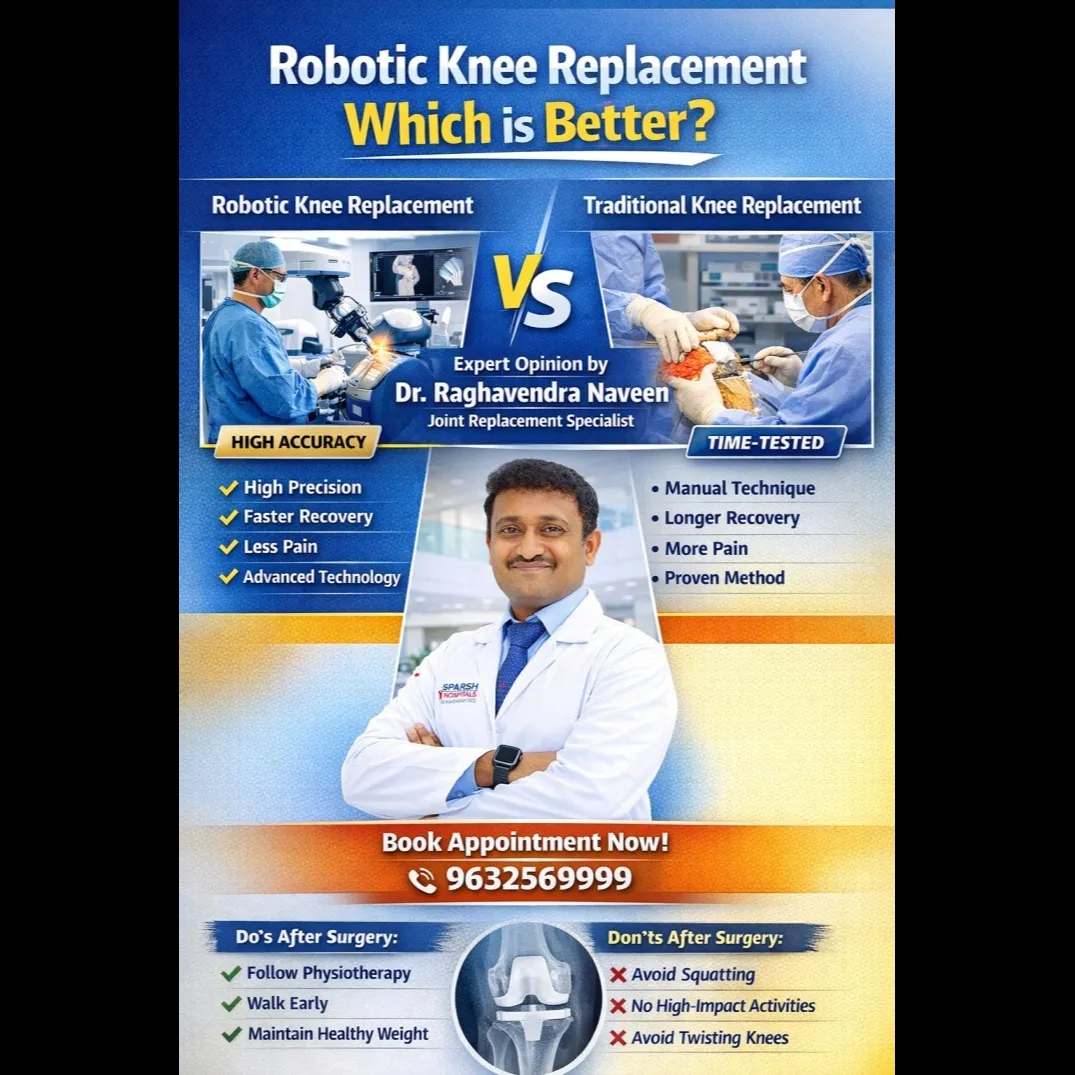
⚖️ Key Differences – Robotic vs Traditional
Feature Robotic Knee Replacement Traditional Knee Replacement
Precision Extremely high Good
Implant Alignment Highly accurate Surgeon dependent
Tissue Damage Minimal Moderate
Pain After Surgery Less Slightly more
Recovery Speed Faster Standard
Technology Advanced robotic system Manual technique
Outcome Predictability Very consistent Variable
💡 Which is Better?
👉 Robotic Knee Replacement is better if you want:
Higher accuracy and precision
Faster recovery and less pain
Better long-term implant performance
👉 Traditional Knee Replacement is suitable if:
You have standard arthritis
Robotic systems are not required
You prefer a proven conventional approach
✔ Conclusion:
Both are effective, but robotic knee replacement offers superior precision, faster recovery, and better outcomes, making it the preferred modern choice.
🚀 Benefits of Robotic Knee Replacement
Precise implant positioning
Reduced complications
Less blood loss
Faster rehabilitation
Improved joint function
Longer implant life
🔄 Recovery Comparison
7
Robotic Surgery:
✔ Walking within 24 hours
✔ Faster return to normal life
Traditional Surgery:
✔ Slightly longer recovery
✔ More post-operative discomfort
✅ Do’s and ❌ Don’ts After Knee Replacement
✅ Do’s
Start walking early as advised
Follow physiotherapy strictly
Maintain ideal body weight
Keep surgical wound clean
Attend regular follow-ups
❌ Don’ts
Avoid squatting or sitting cross-legged early
Avoid high-impact activities
Do not skip rehabilitation
Avoid sudden twisting movements
Do not ignore swelling or pain
🌟 Why Choose Dr. Raghavendra Naveen?
Specialist in robotic & advanced knee replacement surgery
High success rates and patient satisfaction
Personalized rehabilitation programs
Advanced technology and precision techniques
Trusted care in Yelahanka & Hebbal, Bangalore
📍 Book Consultation Today
Confused about the right surgery? Get expert guidance tailored to your condition.
👉 Consult Dr. Raghavendra Naveen
Orthopedic & Joint Replacement Specialist
📍 Yelahanka | Hebbal, Bangalore
📞 Call: 9632569999
❓ Frequently Asked Questions (FAQ)
1. Is robotic knee replacement safer than traditional surgery?
Yes, it offers higher precision and reduces the chances of alignment errors.
2. Does robotic surgery reduce pain?
Yes, due to minimal tissue damage, post-operative pain is usually less.
3. Is robotic knee replacement expensive?
It may be slightly more expensive but offers better long-term outcomes.
4. How long does recovery take?
Most patients recover in 4–8 weeks, with full recovery in a few months.
5. Which surgery lasts longer?
Both are durable, but robotic surgery may improve implant longevity due to better alignment.
Expert Knee Replacement Guide by Dr. Raghavendra Naveen | Bangalore
📞 Call Now: 9632569999
Knee arthritis is one of the most common causes of chronic pain and reduced mobility. When non-surgical treatments fail, knee replacement becomes the best solution. Today, patients often ask:
👉 “Should I choose robotic knee replacement or traditional knee replacement?”
At our centers in Yelahanka & Hebbal, Bangalore, Dr. Raghavendra Naveen offers both advanced options, helping patients choose the most suitable treatment for long-term success.
🔍 Understanding the Two Techniques
🔹 Traditional Knee Replacement
A conventional surgical method where the surgeon uses manual instruments to replace the damaged knee joint.
✔ Proven technique with long-term results
✔ Widely practiced worldwide
✔ Outcome depends on surgical precision
🤖 Robotic Knee Replacement
An advanced technique where robotic technology assists the surgeon with 3D planning and real-time accuracy.
✔ Computer-guided precision
✔ Better implant alignment
✔ Minimal soft tissue damage
⚖️ Key Differences – Robotic vs Traditional
Feature Robotic Knee Replacement Traditional Knee Replacement
Precision Extremely high Good
Implant Alignment Highly accurate Surgeon dependent
Tissue Damage Minimal Moderate
Pain After Surgery Less Slightly more
Recovery Speed Faster Standard
Technology Advanced robotic system Manual technique
Outcome Predictability Very consistent Variable
💡 Which is Better?
👉 Robotic Knee Replacement is better if you want:
Higher accuracy and precision
Faster recovery and less pain
Better long-term implant performance
👉 Traditional Knee Replacement is suitable if:
You have standard arthritis
Robotic systems are not required
You prefer a proven conventional approach
✔ Conclusion:
Both are effective, but robotic knee replacement offers superior precision, faster recovery, and better outcomes, making it the preferred modern choice.
🚀 Benefits of Robotic Knee Replacement
Precise implant positioning
Reduced complications
Less blood loss
Faster rehabilitation
Improved joint function
Longer implant life
🔄 Recovery Comparison
7
Robotic Surgery:
✔ Walking within 24 hours
✔ Faster return to normal life
Traditional Surgery:
✔ Slightly longer recovery
✔ More post-operative discomfort
✅ Do’s and ❌ Don’ts After Knee Replacement
✅ Do’s
Start walking early as advised
Follow physiotherapy strictly
Maintain ideal body weight
Keep surgical wound clean
Attend regular follow-ups
❌ Don’ts
Avoid squatting or sitting cross-legged early
Avoid high-impact activities
Do not skip rehabilitation
Avoid sudden twisting movements
Do not ignore swelling or pain
🌟 Why Choose Dr. Raghavendra Naveen?
Specialist in robotic & advanced knee replacement surgery
High success rates and patient satisfaction
Personalized rehabilitation programs
Advanced technology and precision techniques
Trusted care in Yelahanka & Hebbal, Bangalore
📍 Book Consultation Today
Confused about the right surgery? Get expert guidance tailored to your condition.
👉 Consult Dr. Raghavendra Naveen
Orthopedic & Joint Replacement Specialist
📍 Yelahanka | Hebbal, Bangalore
📞 Call: 9632569999
❓ Frequently Asked Questions (FAQ)
1. Is robotic knee replacement safer than traditional surgery?
Yes, it offers higher precision and reduces the chances of alignment errors.
2. Does robotic surgery reduce pain?
Yes, due to minimal tissue damage, post-operative pain is usually less.
3. Is robotic knee replacement expensive?
It may be slightly more expensive but offers better long-term outcomes.
4. How long does recovery take?
Most patients recover in 4–8 weeks, with full recovery in a few months.
5. Which surgery lasts longer?
Both are durable, but robotic surgery may improve implant longevity due to better alignment.
Keywords